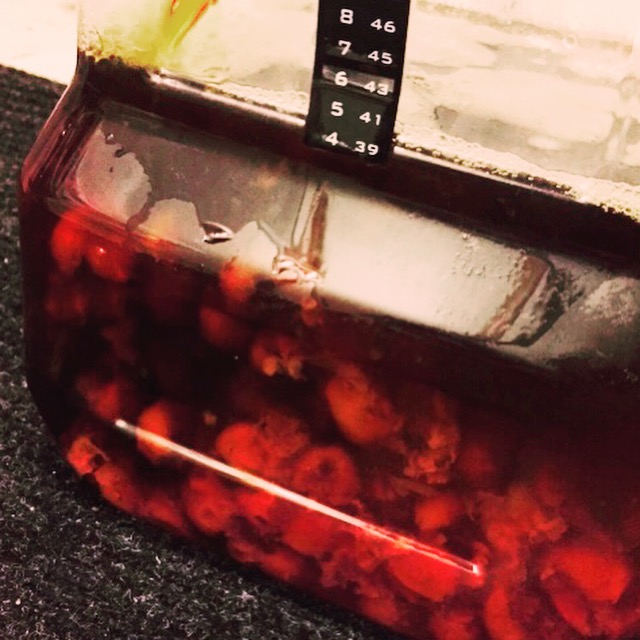
Today I officially tapped the New Zealand Apricot Saison. I snuck in a small taster the other day before the "official" tasting and I was bit concerned. Anyways here is real tasting notes on the official tasting day.
Appearance: 4/5. Probably a bit too hazy for the style. I love the color though. It screams summer beer. The beer is a very cloudy light hay color. Has a lemon cream pie kind of look going on. Cant see through the beer at all (fruit pectin?) Big fluffy white head as it pours out of the tap as it settles out leaving a half inch to quarter inch head. It leaves a small amount of lacing on the glass as you drink it.
Smell: 2/5. Does not smell like a saison and I can barley smell any fruit (apricots). It has a hint of fruit in nose. Mostly a white wine/grape juice smell with a heavy dose of grass-like hop smell.
Taste: 3/5. Unique to say the least. Not like any other saison I have had. Grassy/Hay hop flavor dominates. The wine and dry grape flavor are there too. A tiny bit of fruit comes in at the very beginning but is gone before you know it was really there. If I did not tell you it was brewed with apricots you would probably never guess it.
Mouthfeel: 5/5. For the style this is right on target. Very light and refreshing once you get past the bitter grassy hops. Very dry. Beer ended up at 1.004!
Overall: 2.5/5. I expected more from this beer. To be fair this beer is still really, really young. I much prefer a straight saision vs a super hoppy, fruited version like this one. Hopefully with some time this beer ages into a more refined version of it self. Maybe as the hop flavors die down you will get some more subtle flavors coming through. I also don't know if you would say this is a saison if you had it without know what it was. Little, to no funk going on. This is my first time using White Labs French Saison. Maybe their strain is not nearly as saison-like as the Wyeast version.
If I were to brew again I would not add the fruit. The hops dominate. Or, I would not dry hop this beer at all. Let the 60 minute addition and the flame out hops be the only hops in the beer and then finish with the fruit. I also would go back to Wyeast vs White Labs for the French Saison strain. Maybe the hops are covering up the traditional saison flavors but right now I am a bit let down how "normal" and clean this beer tastes.
If I were to really rethink the recipe as a whole I would just rebrew my previous saison and add apricots to that beer as it was originally constructed.
I learned a lot about the New Zealand hops on this beer. The packaging for Nelson Sauvigon said "White wine like flavors". Boy oh boy are they right with that one!
If this beer ages into something different I will update the post. Until then. Get ready for my next fruited beer - Mango Trois IPA. Should post about this in a week or so.
Oh yeah... the tap is working pretty well!
UPDATE:
Two weeks later and this beer has really smoothed out and started to come together. This just goes to show you that just because you can keg a beer and drink it two days after your fermentation schedule does not mean you should. Time is still your friend for some of these beers.
The subtle fruit flavor is a bit more intense and the super grassy hop flavor has somewhat mellowed out as well. Brings everything back into balance.
I would bump this up to a pretty solid beer and give the smell another quarter point to give it 2.25 (still zero saison smell). Taste would get another half point for the balance it is showing but I am still bummed that no real saison character is showing. 3.5.
Overall would get another half point for everything outlined above. Unless time will reveal some of that traditional saision character, this beer is probably going to max out here. There is some "Brett" trois in this beer so there is still a chance it could turn it into something. I just don't think the keg will last that long.
Friday, July 24, 2015
Saturday, July 11, 2015
Brew Day: Three Blind Mice IPA (Formerly 100% Brett IPA)
Brett Trois (White Labs 644) is not no longer Brett. I have seen it called Wild Saccharomyces. Saccharomyces Trois just doesnt roll off the tongue like Brett Trois. The beer that this yeast makes is wonderful on the palate though - especially IPA. My favorite IPA and close to my favorite beer I have ever brewed was the previously named 100% Brett Trois IPA. Currently going to call this beer 3 Blind Mice keeping with my barn theme and of course a node to Trois.
Here is the description from White Labs: This strain, used traditionally for wild yeast-like fermentations, produces a slightly tart beer with delicate characteristics of mango and pineapple. Can also be used to produce effervescence when bottle-conditioning.
Wild-yeast-like fermentation. Key phrase. This yeast certainly acted like a 100% Brett fermentation when I brewed it last. So I made a starter this time around. Last time the brew day crept up on me and I did not have time to make one. This should help kick the fermentation off faster and produce and even better beer than last time.
Brew day was pretty simple. I did replace the hop extract with regular old Centennial hops. I just added enough to the beginning of the boil to reach my target IBU. I got a gravity reading of 1.066. Two points shy of where I wanted to be but still really good. This beer really dried out. I expect it to go below 1.010. Beersmith says 1.007 is the estimated final gravity. We will see how low it goes.
The only thing I am going to do this year is add a bit of 100% Mango juice. I want to push the beer one step further towards that tropical fruity flavor that the hops and yeast were giving the beer last time. It also continues my experiment with wine and fruit juices in beer. I will post some notes as they happen.
Here is the description from White Labs: This strain, used traditionally for wild yeast-like fermentations, produces a slightly tart beer with delicate characteristics of mango and pineapple. Can also be used to produce effervescence when bottle-conditioning.
Wild-yeast-like fermentation. Key phrase. This yeast certainly acted like a 100% Brett fermentation when I brewed it last. So I made a starter this time around. Last time the brew day crept up on me and I did not have time to make one. This should help kick the fermentation off faster and produce and even better beer than last time.
Brew day was pretty simple. I did replace the hop extract with regular old Centennial hops. I just added enough to the beginning of the boil to reach my target IBU. I got a gravity reading of 1.066. Two points shy of where I wanted to be but still really good. This beer really dried out. I expect it to go below 1.010. Beersmith says 1.007 is the estimated final gravity. We will see how low it goes.
The only thing I am going to do this year is add a bit of 100% Mango juice. I want to push the beer one step further towards that tropical fruity flavor that the hops and yeast were giving the beer last time. It also continues my experiment with wine and fruit juices in beer. I will post some notes as they happen.
Tuesday, July 7, 2015
Brewery Update
![]() |
| Beatrice my trusty cat helper on the floor next to the bottle capper. |
Half way through the year already. I feel like I am not getting nearly enough done. Good news is that work has finally slowed down (enough that I'm not working weekends - currently) and I have some brew days lined up in the very near future. In the meantime I needed to take a full day and just have a maintenance day in my "brewery",
Because I am not 100% up to speed on my sour production I am still brewing a lot of beers for blending mixing with the barrel - or after the barrel - to get the right taste on these first batches. I have three five-gallon barrels. They push out a lot of oak. It's going to take time and more importantly, more batches, to ease out that oak flavor. After more than two years I am just now drinking my sour stout. This one didnt have to go through the barrel because I did not have it ready yet. But the next batch will go on oak. This weekend I finished cleaning and preparing my new barrel. To celebrate that accomplishment I put 5 gallons of a Blackberry Pinot Noir into the barrel. Its going to sit for about 3 months and then the next wave of sour stout will go in. This first batch in the barrel will most likely be filled with too much oak flavor so I will then have to blend and mix that batch. So on, and so on. Until of course the barrel stop giving off the heavy oak flavors.
Another accomplishment of the weekend was bottling my sour red that came out of the barrel. This is the second generation out of the barrel. The first batch was way too much oak flavor. I took that batch and blended it back into clean beer and back into the barrel it went. After it came out I blended yet again with clean beer. This batch is much more tolerable, but it currently still has a heavy oak and full of tannin-like flavors. I recently had a pint of Bells Brewery "The Wild One". My beer has similar flavors. Its a complex beer. It has a bit of harshness mixed with some funky fruit flavors from the Brett. You can kind of get the tart cherry pie aroma when you smell it - reminiscent of a Rodenbach. But it has a punch that Rodenbach does not. I would love to have my beers skew more towards the sharp acidic bite with fruity notes that Rodenbach has vs my beer which I would describe as a beer that smells like a Rodenbach but then punches you in the face with an almost abrasive funk/acid bite. Here's to hoping that the carbonation will add some brightness to the beer and liven it up some. I will check the first bottle in two months.
![]() |
| Sour cherries sit on the bottom of the carboy as I siphon sour red beer on top. A Kriek is a brewing! |
The final batch I mixed up was with black currants and dark raisins. The dried fruit was added to a small one-gallon test batch. Ill be curious to see how this one turns out. I expect this version to push more towards the wine flavor present in the red sour from the barrel. The strong Cabernet Sauvignon flavors may come out more with grapes and currants in the mix. Don't really know what to expect on this one.
On top of mixing and bottling the three beers outlined above I cleaned a lot of carboys and bottles. Since I felt like the Brett was getting out of control I have been cleaning a lot more. For instance I didn't even need to clean some carboys but did anyways. Just cleaning the gear if it has been sitting too long without beer in it.
All and all it was a very productive day. Coming up this weekend though is two brew days. Me and Mike make our second collaborative oat beer. This one wont be as tricky since we are not using any witch weed to brew with. We are making an oat beer with with lemon, ginger and honey. Should be a real summer quencher if it turns out. I will also be brewing my 100% Brett IPA again. Although it probably should be call IPA since they recently found out Brett Trois is really a "Wild Saccharomyces". I will be making one small tweak to the recipe this year by adding just a touch of mango juice to the secondary to really push the tropical flavors.
I should have a tasting note for my La Fin Du Maz shortly as well. It's the first beer I put into a keg and it should be ready to sample tomorrow.
Finally, I will be putting my saision on tap soon. This is my New Zealand Apricot Saison.
Monday, June 22, 2015
Building a Keggerator
![]() |
| Finished project. Just need to add a drip tray. |
Step One: Plan like crazy. Look at your fridge. Think of how you want it set up. Determine if you want small kegs or typical 5G sized kegs. You will be doing this with a lot of unknowns but you should try to visualize exactly what you want. Watching all of the YouTube videos will help you understand what is possible for your scenario
Step Two: Go to a good homebrew shop or online store that can supply you everything you need while walking you through what part does what. In my case it was Country Wines in North Hills of Pittsburgh. I said I have a standard fridge with a top freezer from the 90's and want to fit two kegs and a small CO2 tank so everything can be held inside the fridge. They then went to the shelves and pulled everything out one by one telling me what the piece does and how to hook it up or put it together.
Step Three: Do a dry run of your system to get a feel for the space and how you might like it set up. In my case I put both kegs and the CO2 tank in the fridge and tried to move my shelves around to squeeze out as much storage as possible. I then figured out where the taps would go on the door and had a rough idea of where those would be placed.
Step Four: (Enter my dad) I discuss my plan and he concludes that it should work out as I planned. We measure the spot for the taps to go into the door. I measured to make sure they fit within the one shelf of the fridge door while also being low enough that when I open the freezer the taps dont kick open and pour precious beer everywhere! We mark the outside of the fridge with our marks for the hole saw. We made the tap handles four inches apart.
Step Five: Pre drill through the door to have a guide for your hole saw drill to do its thing. Then drill the hole saw through the metal side of the fridge door. Stop the drill and remove the circle of metal. Continue drilling through to to the other side. Most fridges are not going to have anything in the door other than metal, plastic and foam.
Step Six: Put a small piece of wood on the inside of the door to distribute the pressure from the hex nuts. We held up the piece of wood after cutting it to size against the inside of the fridge. My dad then did a quick drill to mark where the hole saw needed to go through the wood. Finish drilling with the hole saw.
Step Seven: Insert the tap shank into the hole and the wood. Put the hex nut on the wood side and then screw on the taps. Tighten until the taps arent spinning around and you are not flexing the plastic too much. Snug. Not death grip.
Step Eight: Hook everything up. Hook up all of your hoses as outlined by your LHBS. Use hose clamps on all ends. Hook up regulator to the CO2 tank. Hook the beverage tubing up to the tap shanks and the kegs. Hook everything up. All of it!
Step Nine: Once you have everything hooked up you should run cleaner through your system. I had my kegs pre-filled with cleaner solution. So once everything was hooked up we tested the gas. Turned everything on. Tested the pressure. Put water and soapy solution over all of the placed gas could leak to test for any small leaks. Test the lids. I had my lid off center ever so slightly and a nasty hiss kicked in sa soon as the gas was turned on. Turn of the gas and try, try again. Once you have a leak free system have 4lbs of CO2 on the water and cleaning solution and let it flow. Pull the taps forward and run all of the solution through the keg or kegs. Rinse with water and repeat. Finally. Sanitize. Now you are at the best step.
Step Ten: Put homebrew in the keg. Hook it all up and set your regulator to your desired PSI. (I have not even done this part yet so I wont pretend to know for sure). I am going to sue this site and calculator to start and see how it goes with my system and particular setup:
http://www.brewersfriend.com/keg-carbonation-calculator/
Wait 7-10 days. Try the beer. Hopefully enjoy!
So that's it. It only took about 1.5 hours for me and my dad to get it set up and the first two kegs cleaned and run through the system.
Once I get some time to finish kegging my beer I plan to do that while bottling a few for long term aging.
Hopefully you see a post on that within the next ten days.
Cheers.
Thursday, June 18, 2015
Tasting Day: Barn-Cat Black Sour Stout
Work has been tough sledding lately. I rewarded my accomplishment of the day (finishing Wednesday) by cracking open the 3 month old sour stout. I really want to check in along the way to see what this beer is doing in the bottle. Here is my quick recap:
One month in bottle: It was way better than it should have been. Setting expectations pretty damn high.
Two months in the bottle: It was all over the place. The fresh stout flavors were really competing with the sour flavor.
Three months in the bottle: More calmed down. Still has some abbrassive qualities but they die out after the beer opens up in the glass for a bit.
The good news is that its getting better and I can tell that the beer is starting the meld together better. After the three sip rule - the rule where someone must take three drinks of a sour beer before truly knowing what the beer tastes like - this beer is really, really good. The first two and maybe even third sip are tougher than they should be. You get punched in the face with acidity and some funky roast flavors. You know you are drinking an American sour. It let's you know what it is right up front.
As the beer sits and warms up a bit in the glass that abbrassive bite fades and it becomes a great sipping beer. The sour, tart and slightly tar-like bite form this weirdly refreshing beer. I kept going back for a sip quicker and quicker.
I drank a full 750mL by myself in a pretty short amount of time. That right there shows that there is something in this beer. I plan to crack one more before the fall to see how its doing. My friend who introduced me to sours needs to come out and have one soon just so he can see how it is doing. He has heard me talk about it for over 2 years now so I think he might deserve a glass or two.
After that bottle is done I am going to sit on it until stouts are back in season - let's say September or October at the earliest. I will plan to drink one a month to track the progress until I have one left. That one will sit for a long time. I want to see how it lasts over at least 2 years in the bottle.
I am going to bottle the Blackberry Barn-Cat Black Sour Stout later this month or early June and start tasting those around September or October as well.
One month in bottle: It was way better than it should have been. Setting expectations pretty damn high.
Two months in the bottle: It was all over the place. The fresh stout flavors were really competing with the sour flavor.
Three months in the bottle: More calmed down. Still has some abbrassive qualities but they die out after the beer opens up in the glass for a bit.
The good news is that its getting better and I can tell that the beer is starting the meld together better. After the three sip rule - the rule where someone must take three drinks of a sour beer before truly knowing what the beer tastes like - this beer is really, really good. The first two and maybe even third sip are tougher than they should be. You get punched in the face with acidity and some funky roast flavors. You know you are drinking an American sour. It let's you know what it is right up front.
As the beer sits and warms up a bit in the glass that abbrassive bite fades and it becomes a great sipping beer. The sour, tart and slightly tar-like bite form this weirdly refreshing beer. I kept going back for a sip quicker and quicker.
I drank a full 750mL by myself in a pretty short amount of time. That right there shows that there is something in this beer. I plan to crack one more before the fall to see how its doing. My friend who introduced me to sours needs to come out and have one soon just so he can see how it is doing. He has heard me talk about it for over 2 years now so I think he might deserve a glass or two.
After that bottle is done I am going to sit on it until stouts are back in season - let's say September or October at the earliest. I will plan to drink one a month to track the progress until I have one left. That one will sit for a long time. I want to see how it lasts over at least 2 years in the bottle.
I am going to bottle the Blackberry Barn-Cat Black Sour Stout later this month or early June and start tasting those around September or October as well.
Sunday, June 7, 2015
Brew Day - Saison - New Zealand Funk
Today I brewed up a saison. This saison is different than my last batch. This one is highly hopped and hopped with New Zealand hops. I was listening to the sour hour when Sante Adairius Rustic Ales was a guest and they discussed West Ashley, an apricot saison with Chardonnay grapes. This reminded me of a post from the Mad Fermentationist: http://www.themadfermentationist.com/2014/08/new-zealand-saison-and-glycosides.html
I decided to combine the two. The hops used all have descriptions of stone fruit, citrus fruit and white wine. Seems to be a perfect fit for the Chardonnay wine addition along with apricot puree.
The brew day went pretty well. I did have a pretty large boil over which resulted in me getting less than 5 gallons or wort into the carboy for fermentation but that's OK.
There was also a lot of trub. With 6 oz of hops going into this beer just for primary it had a lot of green left behind.
I added the yeast at 80 degrees since the saison strains love warmer worts. I used the White Labs French Saison vs Wyeast this time. I hope to get similiar results. The description online does not mention fruit like the Wyeast so hopefully its just a more tame version of the Belgian Saison strains.
I will update as the beer progresses.
UPDATE:
After about 10 days the airlock finally started to slow. It was a slow and steady fermentation. I'm sure the Brett Trois ate through some sugars that the French Saison yeast couldn't.
The smell from the airlock was anywhere from super fruity - almost like fruit flavored bubblegum - to super funky. The fruity scent has to be from the hops and the French Saison yeast while the funkiness is coming from the Brett Trois and the French Saison yeast. If the Whitelabs French Saison is anything like the Wyeast strain, this beer should have a more subdued funk and a bigger fruit nose.
I transferred the beer into a secondary carboy along with 96oz of canned apricots. The beer is currently undergoing another round of fermentation with the added fruit sugars right now. I will give it about 2 weeks to chew through those sugars before putting into a keg and a few bottles.
I decided to combine the two. The hops used all have descriptions of stone fruit, citrus fruit and white wine. Seems to be a perfect fit for the Chardonnay wine addition along with apricot puree.
The brew day went pretty well. I did have a pretty large boil over which resulted in me getting less than 5 gallons or wort into the carboy for fermentation but that's OK.
There was also a lot of trub. With 6 oz of hops going into this beer just for primary it had a lot of green left behind.
I added the yeast at 80 degrees since the saison strains love warmer worts. I used the White Labs French Saison vs Wyeast this time. I hope to get similiar results. The description online does not mention fruit like the Wyeast so hopefully its just a more tame version of the Belgian Saison strains.
I will update as the beer progresses.
UPDATE:
After about 10 days the airlock finally started to slow. It was a slow and steady fermentation. I'm sure the Brett Trois ate through some sugars that the French Saison yeast couldn't.
The smell from the airlock was anywhere from super fruity - almost like fruit flavored bubblegum - to super funky. The fruity scent has to be from the hops and the French Saison yeast while the funkiness is coming from the Brett Trois and the French Saison yeast. If the Whitelabs French Saison is anything like the Wyeast strain, this beer should have a more subdued funk and a bigger fruit nose.
I transferred the beer into a secondary carboy along with 96oz of canned apricots. The beer is currently undergoing another round of fermentation with the added fruit sugars right now. I will give it about 2 weeks to chew through those sugars before putting into a keg and a few bottles.
Sunday, May 17, 2015
Brew Day: The Beginning of the End
This weekend I finally got around to brewing. I was supposed to brew this beer about 3 weeks ago. Weather and life just got in the way. At the time I am calling this beer the Beginning of the End. Essentially it is a La Fin du Monde clone. I am making it for my friend who recently started drinking good beer. His gateway drug? La Fin du Monde. This is the same friend that I had to make a hard lemonade for so he has come a long way. I should start a series called the Friendship Series and keep track of these beers. We will save that for another post.Everything went smooth on this brew day except for one thing. I forgot to take a OG reading. My wort chiller busted on the previous brew day and I just plain forgot to buy a new one. I was left with only a cold water bath to cool my brew down to pitching temps. By the time my beer got to temp I forgot to take the reading. I guess you can say two things went wrong as I did not want to let the beer sit that long while it cooled. I much prefer using a wort chiller and getting it cooled down in a half hour at the most. This took many hours because it was hot yesterday and it just took too damn long.
Fermentation was rolling this afternoon so it took off in less than 24 hours. Not too bad considering I did not use a yeast starter.
This may be the first beer I keg. More on that later.
Until then...
Update:
This beer sat in the primary for two weeks and one day. This was due to my travel and not necessarily planned. I have been thinking about really reducing my secondary time as I hear more and more people say it is not worth the risk of adding more oxygen to your beer. Some are even abandoning the secondary all together.
Its a very nice straw yellow color. Still cloudy. Hopefully that clears up some. Smells like a nice Belgian beer.
This will be my first beer on tap. I have 4 mini kegs (3gallons each) coming to the house tomorrow. I am stopping at the homebrew shop to put in a grain order for a new beer along with buying the rest of the supplies to get up and running.
Really excited about this development. Having 4 kegs will let me age 2 beers while having two on tap.
Subscribe to:
Posts (Atom)